
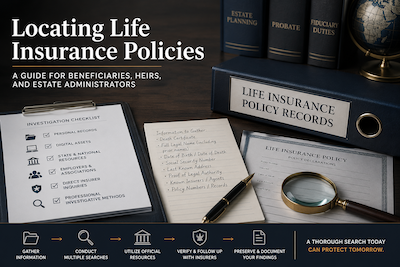
Locating Life Insurance Policies: A Guide for Beneficiaries, Heirs, and Estate Administrators
Every year, substantial life insurance and annuity benefits go unclaimed—not because no coverage existed, but because beneficiaries, heirs, or estate representatives did not know about the coverage, could not identify the insurer, or did not know where to begin searching.
There is no single national database that identifies every life insurance policy in the United States. Locating potential coverage is therefore best treated as a structured investigative process. A thorough search usually requires multiple channels: personal records, national locator services, state insurance department resources, unclaimed property databases, employer and association inquiries, military or federal benefit systems, digital records, direct insurer outreach, and, when appropriate, professional investigative methods.
Executive Summary
This guide explains the principal methods for locating life insurance policies and annuity contracts after a death. It is intended for beneficiaries, heirs, estate administrators, attorneys, advisors, and others assisting with estate matters.
A successful search typically combines:
- Personal, financial, and household record review
- Digital asset and email searches
- National locator tools, including the NAIC and MIB resources
- State Department of Insurance and unclaimed property resources
- Direct outreach to known or suspected insurers
- Employer, union, association, military, and federal benefit inquiries
- Financial advisor, attorney, accountant, and insurance agent outreach
- Advanced investigative methods in complex cases
Before You Begin: Documents and Information to Gather
Before submitting formal search requests or contacting insurers, gather as much of the following as possible:
- Certified death certificate
- Decedent’s full legal name, including prior names or aliases
- Date of birth and date of death
- Social Security number, if available
- Last known address and prior states of residence
- Requestor’s full name, contact information, and relationship to the decedent
- Proof of legal authority, such as letters testamentary, letters of administration, or other estate appointment documents
- Known beneficiary information, if available
- Names of former employers, unions, professional associations, military service branches, financial advisors, attorneys, accountants, and insurance agents
- Any known insurer names, policy numbers, premium notices, cancelled checks, or bank transactions
Most formal locator services and insurers will require at least a death certificate and enough information to identify the decedent. Some services also require proof that the requestor is legally authorized or has a qualifying relationship to the decedent.
Step 1: Review Personal, Financial, and Household Records
Before using a formal locator service, begin with the decedent’s own records. This step often produces the most direct leads and can make every later search more efficient.
Records to Review
- Personal papers and address books: Look for names of insurance agents, attorneys, estate planners, financial advisors, or accountants.
- Safe deposit boxes and home files: Search for policy contracts, premium notices, annual statements, loan notices, beneficiary forms, or insurer correspondence.
- Bank statements and cancelled checks: Look for recurring premium payments, automatic drafts, policy loan payments, or deposits from insurance companies.
- Credit card statements: Identify recurring insurance payments or billing descriptors.
- Federal and state income tax returns: Review 1099 forms, interest income, dividend income, policy loan interest, or demutualization-related distributions.
- Mail received after death: Premium notices, policy anniversary notices, dividend statements, and lapse notices may arrive months after death. Monitor mail for at least one year when possible.
- Employer, union, and association records: Group life benefits may exist through current or former employers, unions, fraternal organizations, professional associations, pension plans, or retirement systems.
- Homeowner’s, automobile, or business insurance agents: The same agent or agency that handled property, casualty, or business insurance may have also placed life insurance.
Important Note on Lapsed Policies
Even if a policy appears to have lapsed, it may still have value. Whole life or other permanent policies may have non-forfeiture provisions, reduced paid-up insurance, extended term insurance, cash value, or other residual benefits. Do not disregard older or apparently inactive policy references without checking with the insurer.
Strengths: Often the most reliable way to identify specific insurers, agents, policy numbers, or payment history.
Limitations: Requires lawful access to records; documents may be incomplete, disorganized, missing, or outdated.
Best Use Case: Always the first step in a thorough search.
Step 2: Search Digital Assets and Electronic Records
Modern insurance records are often stored electronically rather than in paper files. Digital review should be treated as a standalone search channel, especially for decedents who used online banking, email, cloud storage, password managers, or paperless billing.
Digital Sources to Review
- Email accounts
- Online banking and bill-pay history
- Cloud storage accounts
- Scanned document folders
- Password managers or digital vaults
- Mobile phone notes, contacts, and saved documents
- Financial planning software or portals
- Online tax preparation accounts
- Electronic statements from banks, brokerages, employers, and insurers
Suggested Search Terms
- “life insurance”
- “policy”
- “premium”
- “beneficiary”
- “death benefit”
- “annuity”
- “cash value”
- “whole life”
- “term life”
- “universal life”
- “variable life”
- “policy loan”
- “dividend”
- “lapse”
- “conversion”
- “group life”
- Names of suspected insurers, agents, employers, unions, or financial advisors
Access and Authorization
Digital searches should be conducted only with proper legal authority. Executors, administrators, trustees, or other authorized individuals should consult applicable law, estate documents, terms of service, and counsel before accessing private digital accounts.
Strengths: High likelihood of finding policy correspondence, premium notices, insurer portals, agent communications, or billing records.
Limitations: Access may require legal authorization, passwords, device access, court authority, or platform-specific estate procedures.
Best Use Case: Digitally active individuals, paperless billing users, and estates where paper records are limited.
Step 3: Use the NAIC Life Insurance Policy Locator
The National Association of Insurance Commissioners (NAIC) Life Insurance Policy Locator is generally the best formal starting point when the insurer is unknown. It is a free online tool that allows potential beneficiaries, heirs, and estate representatives to submit a request that participating insurers can search against their records.
Resource URLs
How It Works
After agreeing to the online process, the requestor submits identifying information about the decedent, typically including legal first and last name, Social Security number, date of birth, date of death, and requestor contact information.
Participating life insurance and annuity companies search their own records. If a company identifies a match and determines that the requestor is the beneficiary or otherwise authorized, the company contacts the requestor directly. The NAIC itself does not confirm whether a policy exists, does not provide policy information, and does not provide beneficiary information.
Coverage and Cost
The NAIC locator is available nationwide and covers participating insurers’ life insurance policies and annuity contracts. It is free to use.
Limitations
- Insurer participation is not universal.
- A negative result does not prove that no policy exists.
- Response times vary by insurer.
- There is no single centralized status tracker for every insurer’s review.
- If the requestor is not the beneficiary or otherwise eligible, the insurer may not contact the requestor.
Strengths: Free, broad national reach, official regulatory backing, useful when no insurer is known.
Limitations: Voluntary insurer participation; no guarantee of response or confirmation.
Best Use Case: Baseline search for nearly every estate, especially when the insurer is unknown.
Step 4: Consider the MIB Policy Locator Service
MIB, formerly known as the Medical Information Bureau, is an insurance industry membership organization that maintains information related to life, health, disability, and long-term care insurance underwriting. MIB’s Policy Locator Service can help identify application activity for individually underwritten life insurance submitted to participating MIB member companies.
Resource URLs
How It Works
The service searches MIB records for evidence that the decedent applied for individually underwritten life insurance with participating MIB member insurers. If matching application activity is found, the report may identify the carrier, application date, and contact information so the requestor can follow up directly with the insurer.
Importantly, MIB does not confirm that a policy was issued, remained in force, or is payable. It identifies application activity, not final policy status.
Common Submission Requirements
Requirements may change, but the service has historically required:
- Application form
- Death certificate
- Proof of eligibility or authority
- Fee payment
Always verify current requirements directly through MIB before submitting a request.
Cost and Turnaround
MIB is fee-based. The primary document identified the fee as $75, non-refundable, with results generally mailed within approximately 21 business days after receipt of a complete submission. Verify current fees and timing before applying.
Key Limitations
The MIB Policy Locator Service generally does not identify:
- Employer-sponsored or group life insurance that was not individually underwritten
- Guaranteed-issue policies, such as some burial or final expense coverage
- Military-issued coverage, including SGLI or VGLI
- Applications predating the database coverage period
- Non-member carriers
- Policies issued without reportable underwriting activity
- Beneficiary information
California Restriction
The primary document notes that MIB’s Policy Locator Service is unavailable if either the decedent or the requestor is a California resident. For California-related searches, rely primarily on the NAIC locator, state insurance department resources, unclaimed property searches, direct insurer outreach, employer inquiries, and other lawful channels.
Strengths: Can identify otherwise unknown application activity with major participating insurers.
Limitations: Fee-based; does not confirm policy issuance or active coverage; excludes many policy types; eligibility restrictions may apply.
Best Use Case: When individually underwritten coverage is suspected but the insurer is unknown, and when the request qualifies under MIB’s rules.
Step 5: Contact State Departments of Insurance
Many state Departments of Insurance operate their own policy locator services, consumer assistance programs, or complaint/intake channels. Some state programs supplement the NAIC locator; others direct consumers to the NAIC tool. Because insurance regulation is state-based, state insurance departments can be valuable when the decedent had strong ties to a specific state.
Resource URLs
Why State Programs Matter
A state insurance department may be able to:
- Direct you to a state-specific life insurance locator program
- Explain state-specific procedures
- Identify consumer assistance contacts
- Help with insurer inquiries or complaint procedures
- Provide links to state unclaimed property offices
How to Proceed
Contact the insurance department in:
- The decedent’s last state of residence
- Any state where the decedent lived for a significant period
- Any state where the decedent worked, retired, owned property, or may have purchased insurance
- Any state where a suspected insurer, agent, employer, or union was located
Strengths: Free or low-cost; official state-level consumer assistance; useful for state-specific issues.
Limitations: Programs vary significantly by state; some simply refer users to NAIC; response processes differ.
Best Use Case: Decedent had strong ties to one or more states, or where a state-specific locator may supplement the national search.
Step 6: Search State Unclaimed Property Databases
If an insurer determined that benefits were payable but could not locate the beneficiary, state law may require the insurer to remit the proceeds to the appropriate state as unclaimed property after the applicable dormancy period. The funds may then be held by a state unclaimed property office for a qualifying claimant.
Resource URLs
How to Search
Search by:
- Decedent’s full legal name
- Prior names or maiden names
- Last known address
- Prior addresses
- States where the decedent lived or worked
- Names of trusts, estates, businesses, or related entities, if applicable
Practice Note
There is no single comprehensive unclaimed property database that covers every state and every category of property. MissingMoney.com searches participating states and is a useful starting point, but a thorough search should include each state where the decedent lived, worked, owned property, maintained financial accounts, or had insurance relationships.
Use official state unclaimed property websites. Avoid paying private “finder” services unless there is a specific reason to do so and the fee arrangement is lawful and understood.
Strengths: Free through official channels; useful for older claims or benefits already remitted to a state.
Limitations: Only applies after funds have been reported and transferred as unclaimed property; not a search for all active policies.
Best Use Case: Decedent died years ago, beneficiary was not located, or prior searches suggest benefits may already have been escheated.
Step 7: Contact Known or Suspected Insurers Directly
If any record identifies or suggests a specific insurer, contact that company directly. Direct outreach may be faster and more effective than waiting for a response through a locator service.
Leads That May Identify an Insurer
- Premium checks or automatic drafts
- Policy documents
- Annual statements
- Agent correspondence
- Employer benefit documents
- Tax records
- Email correspondence
- Mail received after death
- Demutualization records
- Prior claims or policy loan documents
Information to Provide
- Decedent’s full legal name
- Date of birth
- Social Security number, if available
- Date of death
- Last known address
- Known policy number, if available
- Death certificate
- Requestor’s relationship to the decedent
- Proof of legal authority or beneficiary status
Insurer Record Searches
Many insurers compare policyholder records against death records and may attempt to locate beneficiaries when a match is found. Direct outreach can still accelerate the process and ensure that the insurer has current claimant information.
Resource URL
Strengths: Direct, potentially faster, and effective when a likely carrier is known.
Limitations: Requires a lead; company mergers, acquisitions, and name changes may complicate the search.
Best Use Case: Any time a company name, agent, payment, or policy reference is identified.
Step 8: Contact Employers, Unions, Associations, and Retirement Plans
Employer-sponsored and group life insurance is one of the most commonly overlooked sources of coverage. Group policies often do not involve individual underwriting, which means they may not appear in MIB searches.
Who to Contact
- Current employer at the time of death
- Former employers
- Human resources or benefits departments
- Pension or retirement plan administrators
- Labor unions
- Professional associations
- Fraternal organizations
- Alumni associations
- Trade groups
- Credit unions or membership organizations
What to Ask
- Basic employer-paid group life insurance
- Supplemental employee-paid life insurance
- Dependent life coverage
- Accidental death and dismemberment coverage
- Retiree life insurance
- Continuation or conversion coverage after employment ended
- Benefits through a pension, union, or association plan
Federal Employees’ Group Life Insurance
For federal civilian employees, retirees, or certain compensationers, the Federal Employees’ Group Life Insurance (FEGLI) Program may apply.
Strengths: Group life benefits can be significant and are often missed by families.
Limitations: Requires identifying employers or organizations; coverage may have ended, converted, or reduced after retirement or separation.
Best Use Case: Decedent was employed, recently retired, union-affiliated, or associated with membership organizations.
Step 9: Search Military and Veterans’ Life Insurance Programs
Military and veterans’ life insurance programs operate separately from the NAIC and MIB systems. If the decedent served in the U.S. military, these resources should be checked independently.
Programs to Consider
- Servicemembers’ Group Life Insurance (SGLI): Coverage for eligible active-duty, reserve, and other service members.
- Veterans’ Group Life Insurance (VGLI): Coverage available to eligible veterans after separation, if converted within applicable time limits.
- Family Servicemembers’ Group Life Insurance (FSGLI): Coverage for eligible spouses and dependent children of service members.
- VA-administered life insurance programs: Including VALife, Service-Disabled Veterans Life Insurance, Veterans’ Mortgage Life Insurance, and older policy programs.
- VA unclaimed insurance funds: Funds that may be owed to policyholders or beneficiaries whom VA could not locate.
Resource URLs
- VA life insurance
- VA life insurance contact resources
- VA unclaimed insurance funds search
- VA unclaimed property portal
- SGLI Online Enrollment System information
- milConnect SGLI information
- VA policy access and management
- Prudential VGLI account access
Practical Note
Do not assume that a negative NAIC or MIB search resolves the military benefits question. Military and VA programs must be searched separately.
Strengths: Identifies benefits that may exist entirely outside civilian locator systems.
Limitations: Applies only to service members, veterans, and qualifying family coverage; program rules and administrators vary.
Best Use Case: Decedent served in the U.S. military, was a veteran, or may have had military-related family coverage.
Step 10: Contact Financial Advisors and Professional Contacts
People who assisted the decedent with financial, tax, estate, or insurance planning may have records or knowledge of coverage.
Contacts to Consider
- Insurance agents or brokers
- Financial planners
- Investment advisors
- Accountants and tax preparers
- Estate planning attorneys
- Probate attorneys
- Trust officers
- Bankers
- Business partners
- Bookkeepers
What to Ask
- Life insurance policies
- Annuity contracts
- Buy-sell agreements funded by life insurance
- Key person insurance
- Trust-owned life insurance
- Premium payment history
- Policy loans
- Beneficiary designations
- Former insurers or agents
Strengths: Advisors may know about policies not found in household records and may have historical records.
Limitations: Privacy obligations may require proof of authority; some professionals may no longer be practicing or may have limited record retention.
Best Use Case: Decedent had financial, estate, business, or tax planning relationships.
Step 11: Use Advanced or Professional Investigative Methods When Appropriate
In complex cases, professional investigators, attorneys, or specialized research providers may use additional lawful methods to identify indirect indicators of insurance coverage.
Examples of Advanced Methods
- Credit header or identity data to identify historical addresses and possible insurer relationships
- Public records research, including probate filings, court records, and recorded documents
- UCC filings where policy collateral assignments or business arrangements may appear
- Business records involving buy-sell agreements, key person insurance, or collateral assignments
- Subscription databases that aggregate financial, public-record, or contact information
- Prior address and name-history research
- Corporate merger and insurer successor research
- Agent licensing and appointment research through state insurance departments
Compliance Considerations
Advanced investigative methods must comply with applicable privacy, consumer reporting, data protection, probate, and professional licensing laws. Some databases and search methods are restricted to permissible purposes or licensed users.
Strengths: Can uncover indirect leads not visible through standard channels.
Limitations: Requires specialized access, legal compliance, and careful interpretation; may identify leads rather than confirmed coverage.
Best Use Case: Complex estates, no records, suspected older policies, business insurance, multi-state matters, or situations where standard searches are inconclusive.
Comparison of Primary Search Tools
| Method | Cost | What It Searches | Key Limitations | Best Used When |
|---|---|---|---|---|
| NAIC Life Insurance Policy Locator | Free | Participating insurers nationwide; life policies and annuities | Voluntary insurer participation; no guarantee of response | Starting point for most searches; unknown insurer |
| MIB Policy Locator Service | Fee-based; verify current fee | Application activity with participating MIB member insurers | Does not confirm policy issuance; excludes group, military, guaranteed-issue, some older or non-member activity | Individually underwritten coverage is suspected and insurer is unknown |
| State Department of Insurance Programs | Usually free | Varies by state; may supplement NAIC | State programs vary widely | Decedent had strong ties to a particular state |
| State Unclaimed Property Databases | Free through official channels | Benefits already remitted to a state as unclaimed property | Does not identify active policies not yet escheated | Older estates or suspected unclaimed benefits |
| Direct Insurer Outreach | Free | A specific insurer’s records | Requires identifying or suspecting a carrier | Records, payments, agent names, or mail identify a company |
| Employer / Union / Association Inquiry | Free | Group or membership-based coverage | Requires identifying employers or organizations | Decedent was employed, retired, union-affiliated, or association-affiliated |
| FEGLI / Federal Benefits | Free to inquire | Federal employee or retiree life insurance | Applies only to eligible federal employment situations | Decedent was a federal employee, retiree, or compensationer |
| Military / VA Programs | Free to inquire | SGLI, VGLI, FSGLI, VA-administered programs, VA unclaimed insurance funds | Separate systems; applies only to service-related coverage | Decedent served in the U.S. military or had related family coverage |
| Digital Asset and Email Search | Usually free if authorized | Email, cloud records, digital statements, insurer portals | Requires lawful access | Digitally active decedents; paperless billing |
| Professional Investigative Methods | Varies | Public records, specialized databases, indirect financial indicators | Requires compliance and expertise | Complex or multi-state searches; no obvious leads |
Recommended Search Sequence
A comprehensive search should be coordinated across multiple channels rather than relying on a single tool.
- Review personal, financial, household, and mail records. Identify insurers, agents, employers, policies, payments, and correspondence.
- Search digital records. Review email, online banking, cloud storage, password managers, and digital files using targeted search terms.
- Submit a request through the NAIC Life Insurance Policy Locator. This free national tool should be used early in most searches.
- Search state unclaimed property databases. Use MissingMoney.com, NAUPA, USA.gov, and individual state databases for every state connected to the decedent.
- Contact known or suspected insurers directly. Do not wait for locator results if a lead points to a specific company.
- Contact employers, unions, associations, and retirement plans. Group life and retiree coverage must be investigated separately.
- Check FEGLI, military, and VA programs if applicable. These systems operate outside standard civilian locator tools.
- Contact relevant state Departments of Insurance. Ask about state-specific locator programs and consumer assistance.
- Use the MIB Policy Locator Service if appropriate. Consider MIB where individually underwritten coverage is suspected, no insurer is known, and the request qualifies under MIB rules.
- Contact advisors and professional contacts. Reach out to insurance agents, brokers, financial planners, accountants, and attorneys.
- Consider advanced investigative methods. Use lawful professional assistance when the estate is complex, leads are limited, or standard searches are inconclusive.
Practical Considerations
No Single Search Is Conclusive
A negative result from one tool does not prove that no policy exists. NAIC, MIB, state programs, unclaimed property databases, employer records, military systems, and direct insurer searches each cover different universes of information.
Time Matters
Some benefits may be easier to locate soon after death, while mail is still arriving, employer records are easier to access, and advisors or agents can be identified. At the same time, older estates may require deeper unclaimed property and historical insurer research.
Company Names Change
Life insurers merge, demutualize, sell blocks of business, or change names. If a policy references an old company name, search successor companies and contact the relevant state insurance department for assistance.
Documentation Should Be Organized
Maintain a search log that records:
- Date of inquiry
- Organization contacted
- Contact person or department
- Website or phone number used
- Information submitted
- Documents provided
- Response received
- Follow-up date
Privacy and Legal Compliance Are Essential
Do not misrepresent authority, access accounts unlawfully, or obtain restricted data without a permissible purpose. When in doubt, consult legal counsel.
When to Seek Professional Assistance
Professional assistance may be appropriate when:
- No policy documents, insurer names, or payment records can be found
- The estate is large, contested, or complex
- The decedent lived, worked, or held assets in multiple states
- The decedent owned a business or may have had key person, buy-sell, or collateral assignment coverage
- There may be older policies, lapsed policies, converted policies, or successor insurers
- The decedent served in the military or worked for the federal government and benefits are unclear
- Family members lack authority, access, or time to coordinate the search
- Digital records are difficult to access lawfully
- Standard NAIC, MIB, insurer, and unclaimed property searches are inconclusive
A professional investigator, attorney, estate administrator, or specialized research provider can help coordinate multi-channel searches, document results, identify insurer successors, access lawful databases, and manage compliance requirements.
Key Resource URLs
National Locator and Insurance Regulator Resources
- NAIC Life Insurance Policy Locator
- NAIC Life Insurance Policy Locator information page
- NAIC State Insurance Department Directory
- NAIC State Insurance Department Contacts
MIB Policy Locator
Unclaimed Property Resources
Life Insurance Industry Resource
Federal Employee Life Insurance
Military and Veterans’ Life Insurance
Conclusion
Locating life insurance coverage is rarely a single-step process. Because no universal database captures every policy, annuity, employer benefit, military program, or unclaimed benefit, a disciplined multi-source search is the best approach.
Start with the decedent’s records, then use national locator tools, state resources, unclaimed property databases, direct insurer outreach, employer and association inquiries, digital records, and applicable government or military systems. When standard searches do not resolve the question, professional assistance may help identify indirect leads, insurer successors, and lawful investigative options.
A careful, documented search can significantly improve the likelihood that all available benefits are identified and properly claimed.
Download the PDF Guide
Prefer a copy you can save, print, or share? Download the PDF version of this guide.
Download PDF GuideDisclaimer
This guide is provided for informational purposes only and does not constitute legal, financial, tax, or insurance advice. Laws, procedures, eligibility rules, fees, and third-party service availability may change. Always verify current requirements directly with each organization or agency before submitting a request or claim. Estate representatives and beneficiaries should consult qualified legal or financial professionals regarding their specific circumstances.